
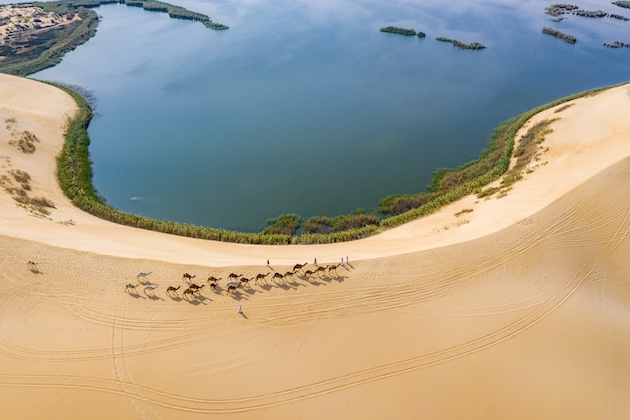

Saudi Arabia’s Red Sea coast is undergoing a deliberate conversion from a largely undeveloped natural frontier into a regulated tourism economy. Stretching roughly 1,846 km from Haql to Jazan, the coastline holds about 1,150 of the Kingdom’s 1,285 islands and some of the world’s most biodiverse coral system assets that until recently generated little economic return.
The macro backdrop is a national tourism sector that reached SAR304 billion (about USD81 billion) in combined domestic and inbound spending in 2025, with roughly 123 million visitors and 29.3 million international arrivals. These are Kingdom-wide figures, not Red Sea totals, but they signal the demand pool the coast is positioned to capture as leisure travel now accounts for about 52% of inbound overnight visits, up from 44% in 2019, displacing purely religious tourism.
The investment case spans the coastal value chain, though at uneven stages of maturity. At the developed end sit flagship destinations built by PIF-owned Red Sea Global, which will open Phase One of both The Red Sea and Amaala in 2026, moving from developer to operator with an initial cluster of resorts. Amaala’s first phase alone drew SAR51 billion in investment and is designed to cap visitors at 500,000 annually to protect its ecosystems. Cruise tourism is an earlier-stage but fast-moving segment: the Saudi-owned AROYA carried more than 92,000 passengers in its first four operational months, while Cruise Saudi targets 1.33 million cruise passengers by 2037. Marinas, yacht charter, diving, recreational boating, coastal hospitality supply chains, and marine-conservation services remain largely greenfield opportunities defined more by announced capacity than existing activity.
What increasingly separates the Saudi Red Sea from comparable emerging coastal markets is regulatory architecture. The Saudi Red Sea Authority (SRSA), established as the regulator of navigational and maritime tourism within the Red Sea’s geographical scope, issues the licenses and permits governing the sector and sets the rules, standards, and infrastructure requirements operators must meet. It has issued eight regulations for navigational & maritime tourism activities, and licensed marina operators, yacht-charter companies, and, for the first time in the Kingdom, beach operators, whose requirements embed safety, accessibility, and Blue Flag environmental benchmarks. For investors, this converts an ambiguous space into a predictable one: clearer entry conditions, defined standards, and a single regulatory counterparty.
Environmental protection here is structural, not decorative. The reefs, mangroves, and island habitats are the product itself; carrying-capacity caps, renewable-energy commitments, and marine-protection mechanisms exist because degradation would erase the asset’s premium. Regenerative-tourism targets Amaala’s stated aim of a 30% net conservation gain by 2040, treating conservation as a driver of long-term pricing power rather than a cost.
The Saudi Red Sea is not a finished destination; it is an ecosystem being built in sequence, where operational assets, projects under construction, and 2030-horizon targets coexist. Its competitiveness lies not in any single resort, but in the coherence of the system taking shape across the coastline. That coherence is itself a governance outcome: regulation, ecological limits, and investment incentives are being designed to reinforce one another, so that conservation functions not as a constraint on growth, but as the mechanism that sustains it making the coastline both profitable and permanent.